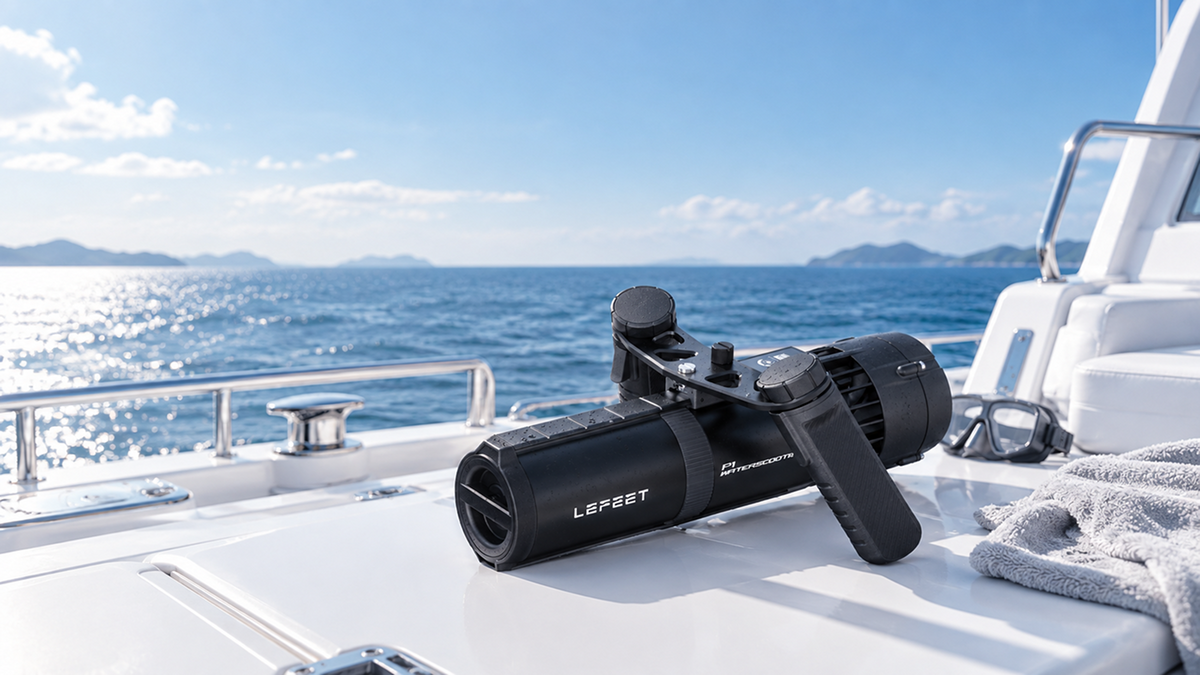
An underwater scooter is a battery-powered device that propels you through the water without kicking. You hold it, mount it to your gear, or attach it to your body, and it does the work of moving you forward.
They are also called DPVs, which stands for Diver Propulsion Vehicle, or sea scooters. All three terms describe the same category of product.
How Does an Underwater Scooter Work?
An electric motor drives a propeller inside a waterproof housing. The propeller pushes water backward, which moves you forward. A battery powers the motor. A trigger, button, or remote control lets you adjust speed.
That is the complete mechanism. The differences between products come down to how much thrust the motor produces, how long the battery lasts, how deep the device can go, and how it attaches to you or your equipment.

Who Uses Underwater Scooters?
Underwater scooters are used across a wide range of water activities.
Recreational snorkellers use them to cover more distance at the surface and just below it, explore further from the shore or boat, and stay in the water longer without tiring.
Scuba divers use them to reach dive sites faster, extend their range underwater, and conserve air by reducing the effort of swimming.
Freedivers use them to assist their descent without disrupting body position, manage currents, and reduce the physical cost of repeated dives in a session.
Underwater photographers and videographers use them mounted to their scuba cylinder, with one hand on the wired remote and the other hand free for the camera while the device provides forward movement.
Yacht and boat owners use them for snorkelling and exploring anchorages, and on paddleboards for powered surface transit.
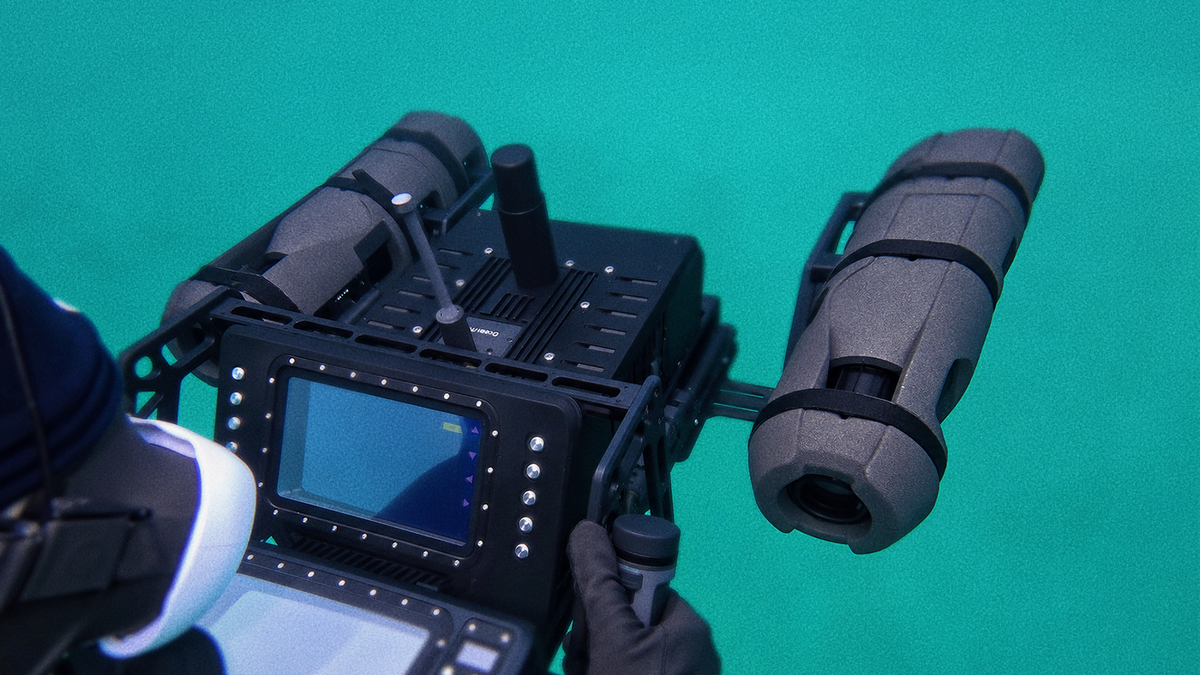
Marine researchers and professionals use them to propel instrument platforms and survey equipment underwater.

What Is a Modular Underwater Scooter?
Most underwater scooters are fixed-form devices: one housing, one purpose, one way to hold them.
A modular underwater scooter separates the motor unit from the mounting system. The same motor clips into different configurations depending on the activity. This means one device covers multiple use cases rather than being locked into a single setup.
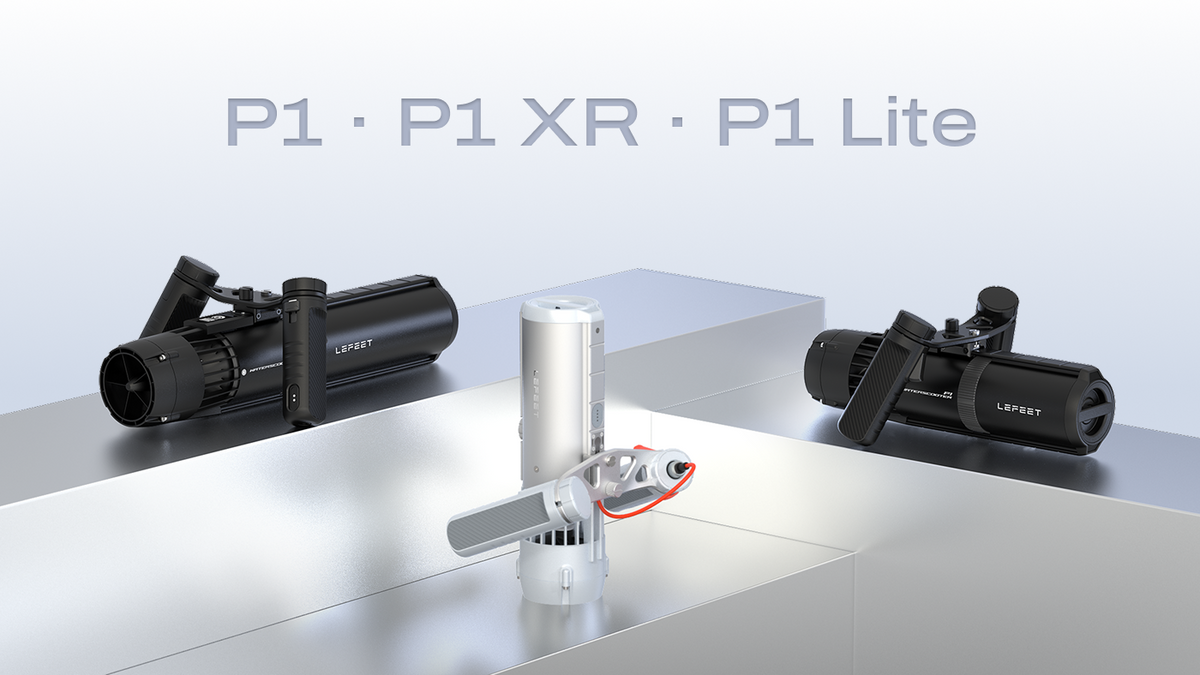
LEFEET designed the P1 and P1 XR around this principle. They share the same motor unit and interchangeable batteries. The P1 Lite is a separate model with its own dedicated accessories.

What LEFEET Set Out to Do
Underwater scooters existed long before LEFEET. The problem was that most of them were large, heavy, expensive, and built primarily for professional or technical divers. Travelling with them was complicated. Getting started with them required significant investment and commitment. For most people who simply wanted to enjoy the water more, they were out of reach.
LEFEET was founded with a different starting point: transform the bulky DPV into something compact, portable, and accessible to anyone who loves being in the water. Not just serious divers. Anyone.
The founding team are divers and water sports enthusiasts themselves. That background shaped a design philosophy built around listening to users and continuing to improve. The leap from the S1 PRO to the P1 represents that philosophy in action: a fundamental rethinking of what a personal underwater propulsion device should be, in terms of size, weight, modularity and travel practicality. You can read about that evolution in detail here.
The goal is not just to make a better scooter. It is to make the underwater world accessible to more people, more easily, more often.
The LEFEET Product Line
LEFEET makes three underwater scooters: the P1 Lite, the P1, and the P1 XR. The differences are in battery capacity, speed, thrust and runtime.

LEFEET P1 Lite
The P1 Lite is the entry-level model, designed for snorkelling, casual reef exploration, and first-time DPV users.
| Spec | P1 Lite |
|---|---|
| Price | $549 |
| Weight | 1.8 kg |
| Max speed | 1.6 m/s |
| Thrust | 8 kgf / 17.6 lbf |
| Max depth | 60 m |
| Battery | 100 Wh (not removable) |
| Runtime | Up to 60 min |
| Charge time | 1.5 h (USB-C) |
| Airline carry-on | 100 Wh, confirm with your airline before travel |
The P1 Lite supports Handheld, Tank Mount, Leg Mount, SUP Mount and Dual Rail configurations using its own dedicated accessories. Two key differences from the P1: the Remote Control Extension Kit is specific to the P1 Lite and is not interchangeable with P1 cables, and the P1 Lite does not have a Buoyancy Float accessory. Check the P1 Lite accessories page for the full compatibility list.
Best for: Snorkellers, beginners, budget-conscious buyers, travel divers who want a lightweight setup.
LEFEET P1
The P1 is the standard model, with more speed and thrust than the P1 Lite and a removable, upgradeable battery.
| Spec | P1 |
|---|---|
| Price | $1,099 |
| Weight | 2.4 kg |
| Max speed (single) | 2.0 m/s |
| Thrust (single) | 9 kgf / 19.8 lbf |
| Dual Unit speed | 3.2 m/s |
| Dual Unit thrust | 18 kgf / 39.7 lbf |
| Max depth | 60 m |
| Battery | 100 Wh, removable and upgradeable |
| Runtime | Up to 60 min |
| Charge time | 1.5 h (USB-C) |
| Speed gears | 4 |
| Reverse charging | Yes, 100W PD 3.1 via USB-C |
| Airline carry-on | 100 Wh, confirm with your airline before travel |
The P1 battery is removable and upgradeable. Swap in the 160 Wh XR battery at any time to unlock P1 XR performance without buying a new motor unit.
Best for: Recreational scuba divers, underwater photographers, travel divers, anyone who wants a system that can grow with their diving.
LEFEET P1 XR
The P1 XR uses the same motor unit as the P1 with a larger 160 Wh battery, unlocking higher speed, longer runtime, and Hurricane Mode.
| Spec | P1 XR |
|---|---|
| Price | $1,299 (check current price at lefeet.com) |
| Weight | 3.2 kg (with battery) |
| Max speed (single) | 2.3 m/s |
| Thrust (single) | 13 kgf / 28.7 lbf |
| Dual Unit speed | 3.6 m/s |
| Dual Unit thrust | 26 kgf / 57.3 lbf |
| Max depth | 60 m |
| Battery | 160 Wh, removable |
| Runtime | Up to 90 min |
| Charge time | 2.5 h (USB-C) |
| Speed gears | 5 (includes Hurricane Mode) |
| Display | OLED screen |
| Airline carry-on | 160 Wh requires advance airline approval, confirm with your airline before travel |
Best for: Experienced divers who need longer runtime, divers who frequently work in current, liveaboard divers doing multiple dives per day.
The Five Configurations
The P1 and P1 XR share the same motor unit and mount system. The P1 Lite supports similar configurations using its own dedicated accessories. Note that the Remote Control Extension Kit is specific to each model and not interchangeable, and the P1 Lite does not have a Buoyancy Float accessory. Switching between configurations takes approximately 30 seconds and requires no tools.
| Configuration | How it works | Best for | Control | Units |
|---|---|---|---|---|
| Handheld | Held in one or two hands, trigger on grip | General diving, snorkelling | Trigger on grip | 1 |
| Tank Mount | Clips to scuba cylinder, one hand holds wired remote | Scuba diving, underwater photography | Wired remote | 1 or 2 |
| Leg Mount | Straps to both thighs | Freediving | Wired remote | 2 |
| SUP Mount | Clips under a paddleboard | Paddleboarding | Wired remote | 1 |
| Dual Rail | Two units side by side | Strong currents, maximum speed | Wireless remote | 2 |
Why LEFEET
LEFEET was founded by a team of divers and water sports enthusiasts with one core belief: that underwater scooters should not be reserved for a niche of technical divers with the budget and logistics for bulky, expensive equipment. The original vision was to transform the traditional DPV into something compact and accessible enough that anyone who loves the water can use one.
That philosophy shaped every decision from the S1 to the P1. The P1 represents a significant leap from its predecessor: lighter, more modular, USB-C charged, and built around a system that grows with the diver rather than constraining them. If you want to understand how far that evolution has come, LEFEET's own team wrote about it: From S1 to P1: The Evolution of Water Mobility.
The design and engineering team are active divers and water sports enthusiasts themselves. User feedback is taken seriously, and the product line continues to be updated in response to it.
One motor unit, five configurations
The P1 and P1 XR share one motor unit across all five configurations. The same motor that powers a handheld snorkel session mounts to your scuba cylinder for photography, straps to your thighs for freediving, clips under a paddleboard for surface transit, and pairs with a second unit on the Dual Rail for maximum thrust.
Replaceable and upgradeable battery
The P1 and P1 XR use the same motor unit with different batteries. Start with the P1 Standard and upgrade to XR performance by purchasing the 160 Wh battery separately. No new motor unit required.
USB-C charging and reverse charging
The P1 battery charges via USB-C and supports 100W PD 3.1 reverse charging. Your dive battery charges your other devices on the boat, at the airport, or in the hotel the night before an early dive.
Design awards and independent recognition
The LEFEET P1 has received the iF Design Award, Red Dot Award and Good Design Award, internationally recognised industrial design awards judged by independent panels.

How to Choose the Right Model
Choose the P1 Lite if:
You are new to underwater scooters, mainly snorkel or do casual reef diving, and want the most affordable entry point into the LEFEET system.
Choose the P1 if:
You scuba dive, freedive, or do underwater photography and want a device that covers multiple activities. You travel frequently and want a removable, upgradeable battery. You want the option to expand to XR performance later by swapping the battery.
Choose the P1 XR if:
You need up to 90 minutes of runtime per dive, frequently dive in current, or do multiple dives per day on a liveaboard. Note that the 160 Wh battery generally requires advance airline approval. Always confirm with your airline before travel.
Key Terms Explained
DPV stands for Diver Propulsion Vehicle. It is the technical term used by dive training agencies and equipment manufacturers. Underwater scooter and sea scooter are common consumer terms for the same category.
Wh stands for watt-hours. It measures how much energy a battery holds. A higher Wh number means more runtime. Airline rules for cabin baggage are based on Wh capacity.
Thrust is measured in kgf, or kilograms-force. It indicates how much force the motor produces. Higher thrust helps in current conditions and when carrying a heavier equipment load.
Modular describes a system where one core unit, the motor, can be reconfigured into different setups without replacing the motor itself.

Frequently Asked Questions
What is the difference between an underwater scooter and a DPV?
They are the same thing. DPV, which stands for Diver Propulsion Vehicle, is the technical term. Underwater scooter and sea scooter are consumer terms. All three describe a battery-powered device that propels a person through the water.
Do I need a diving certification to use an underwater scooter?
No certification is required to use an underwater scooter for snorkelling at the surface. For use at depth during scuba diving, most dive training agencies recommend completing specific DPV training. Using any underwater equipment at depth without appropriate training and experience carries risk.
How deep can LEFEET underwater scooters go?
All three LEFEET models, the P1 Lite, P1 and P1 XR, are rated to 60 m.
How long does the battery last?
The P1 Lite and P1 standard battery (100 Wh) provides up to 60 minutes at moderate speed. The P1 XR battery (160 Wh) provides up to 90 minutes. Actual runtime depends on speed setting, water conditions, current and payload.
Can I take an underwater scooter on a plane?
Battery capacity, airline policy, route and device category all affect whether you can travel with an underwater scooter. Some airlines restrict underwater propulsion devices regardless of battery size or whether the battery is removable. Always confirm with your airline before travel. See our complete airline guide for detailed guidance.
What is a modular underwater scooter?
A modular underwater scooter uses one motor unit that clips into different mounting configurations. The LEFEET P1 and P1 XR support five configurations: Handheld, Tank Mount, Leg Mount, SUP Mount and Dual Rail, all using the same motor unit.
Is an underwater scooter safe?
When used correctly within the product's rated depth and speed limits, with appropriate training and awareness of the environment, underwater scooters are safe recreational equipment. They do not replace dive training, proper planning, buddy diving or personal fitness for the intended activity.
Explore the full LEFEET P1 range at lefeet.com/products/p1. For air travel guidance, see Can You Bring an Underwater Scooter on a Plane?