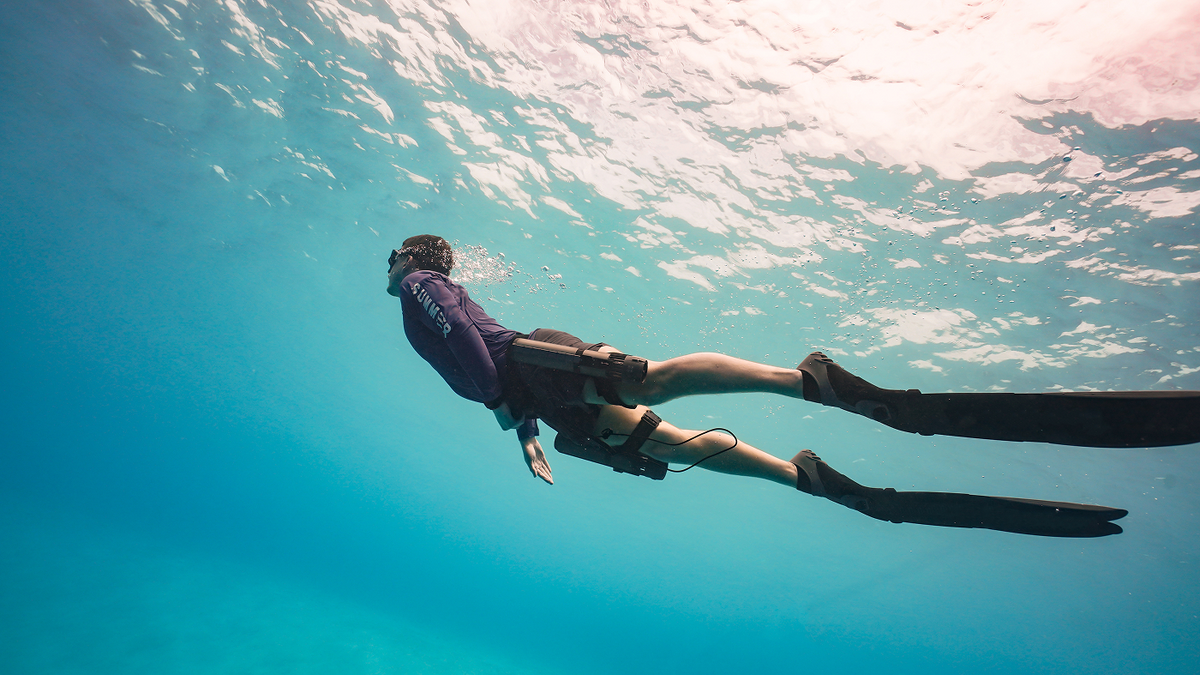
The LEFEET P1 Leg Mount changes a freediver's descent by placing two propulsion units along the legs instead of requiring a scooter to be held in front of the body. This can reduce front-loaded drag and leave the upper body less occupied, but one hand still operates the wired remote. The system does not replace correct weighting, equalization, depth awareness, a trained buddy, or the ability to stop and ascend without motor power.
Safety note: Never freedive alone. Train with a qualified freediving instructor and a dedicated, trained buddy. Use a DPV only after mastering breath-hold safety, equalization, buoyancy, rescue, and self-powered ascent.
What Is a Freediving DPV?
A diver propulsion vehicle, or DPV, is an electric underwater scooter that assists movement through the water. In freediving, it can reduce some swimming effort and change how the diver approaches a site, travels at depth, or holds body alignment.
That assistance also changes risk. A DPV can increase distance and alter depth faster than finning alone. The diver must track depth, direction, buddy position, remaining breath, motor status, and a safe return plan at the same time.
The LEFEET P1 Leg Mount is a modular setup designed around two P1 motor units. Each motor sits on a leg mount, producing balanced propulsion from both sides of the body. The system is controlled through a wired remote with the Remote Control Extension Kit.
The Key Difference: Where the Thrust Begins
A handheld scooter pulls from in front of the diver. A twin Leg Mount produces thrust closer to the diver's longitudinal body line.
1. The upper body carries less equipment
The freediver does not need to hold a full motor unit in front of the chest. One hand still holds and operates the wired remote, but the other hand and most of the upper-body line remain less obstructed.
2. Propulsion is symmetrical
The Leg Mount requires two P1 units, one on each leg. Balanced thrust helps avoid the uneven pull that a single leg-mounted motor could create.
3. Alignment becomes more important
Because the motors follow the legs, body position directly affects the direction of thrust. Bent hips, separated knees, or unequal leg angles can push the diver off line. The mount rewards a long, deliberate position and controlled adjustments.
What It Can Change During Descent
The word “change” matters here. A Leg Mount may alter workload and alignment, but it should not turn a breath-hold descent into an uncontrolled powered drop.
A cleaner front profile
Holding a scooter ahead of the body increases the amount of equipment facing the water. Moving the motors to the legs can create a cleaner front profile and reduce the need to stabilize a heavy object with the shoulders.
Less finning during selected phases
Motor assistance can reduce active kicking during a carefully planned transit or descent phase. This may help a trained freediver limit unnecessary movement, but it does not guarantee a longer or safer breath-hold. Depth, temperature, stress, equalization, current, equipment drag, and individual physiology still shape the dive.
More attention available for equalization
With the motor units out of the hands, the diver may find it easier to maintain an equalization hand position. The other hand still manages the wired remote. Equalize before discomfort, repeat early and often, and abort immediately if equalization fails. Never use motor thrust to push through ear or sinus pain.
A different sense of acceleration
Propulsion near the legs can feel less visually obvious than a scooter held in front. The diver needs clear depth and speed references, plus a planned trigger-release point. A dive computer and visible reference line can help maintain awareness, but equipment does not replace training.
What the Leg Mount Does Not Replace
Correct weighting
A motor can mask poor buoyancy while it is running. When thrust stops, the underlying buoyancy remains. Weight for the dive profile and exposure protection according to freediving training, not according to how the motor feels.
Equalization technique
The DPV cannot equalize the ears or sinuses. If equalization becomes late, difficult, or painful, release the trigger and abort the descent.
A trained buddy
Shallow-water blackout can occur without warning. A dedicated, trained buddy must watch each dive and be positioned to assist according to the dive plan. Two divers descending at the same time are not providing active one-up, one-down supervision.
Self-powered ascent capacity
Every planned depth and distance must remain recoverable if propulsion stops. The diver should be able to release the trigger, manage the equipment, and complete a controlled ascent under personal power.
Depth discipline
Faster access does not create a new safe depth. Stay inside your training, recent experience, equalization ability, conditions, and agreed limits.

LEFEET P1 Leg Mount Setup
The Leg Mount uses two P1 or P1 XR motor units. Do not build the configuration with one unit.
Equipment checklist
- Two compatible P1 motor units
- Two charged and inspected batteries
- LEFEET P1 Leg Mount hardware
- Remote Control Extension Kit
- Charged remote
- Appropriate exposure protection
- Dive computer or depth gauge
- Freediving line, float, lanyard, and other safety equipment required by the session
Dry assembly
- Turn both batteries off.
- Inspect both battery interfaces and sealing rings.
- Install each battery and rotate its locking ring until no gap remains.
- Attach one motor unit to each leg-mount position.
- Route and secure the wired remote extension so it can be reached without loose loops.
- Confirm that straps, cable, lanyard, suit details, and other equipment cannot enter the propeller guards.
- Pair and test control according to the official P1 instructions.
- Confirm that releasing the trigger stops both motors.
Do not test the motors in air. Conduct the operating check only when both propellers are safely submerged and clear.
Fit and Alignment
The mounts should remain stable without restricting circulation or normal movement.
Match both sides
Place the left and right motors at equivalent positions and angles. Unequal placement can produce yaw, roll, or uneven pressure on the legs.
Secure the cable
The extension cable should follow a deliberate route with enough freedom for normal movement but no loop that could catch on equipment, a line, reef, or another diver.
Check the trigger hand
Choose a remote position that allows immediate release. Do not trap the trigger under a glove, strap, or clenched grip. One hand must operate the wired remote during use.
Recheck after entry
Water can change how straps and suits settle. Before beginning a depth dive, perform a shallow check for movement, pressure points, cable routing, and symmetrical thrust.
A Safe Training Progression
Do not introduce the Leg Mount on a maximum-depth session.
Session 1: Surface and horizontal control
In calm, shallow water, practise trigger release, low-speed starts, straight tracking, gentle turns, motor-off finning, buddy communication, and system management according to training.
Session 2: Shallow line work
Use a controlled line setup with a qualified instructor or experienced safety team. Practise brief, low-power phases while maintaining equalization, line awareness, and a conservative depth.
Session 3: Failure rehearsal
At shallow depth, rehearse a motor stop, remote issue, uneven thrust, shifted mount, and aborted descent. The correct response begins with releasing the trigger and stabilizing the dive.
Session 4: Planned use
Only after repeatable control should the system be used on a normal training profile. Set a shallower and shorter limit than the diver's unassisted maximum.
Trigger Discipline on Descent
The most important control is release.
Use short, deliberate power intervals instead of treating the trigger as an automatic descent switch. Release it before equalization becomes rushed, before the planned turn point, and whenever orientation or buddy contact changes.
- Align.
- Check the line and buddy plan.
- Apply low power.
- Equalize early.
- Check depth and direction.
- Release before the turn.
- Stabilize.
- Begin the planned ascent under control.
Do not hold power through discomfort, disorientation, missed equalization, unexpected acceleration, equipment movement, or loss of the planned reference.
The Turn and Ascent
Release the trigger before reaching target depth. Allow time to stop, confirm orientation, and make a controlled turn. Do not rely on the motor to rescue an overextended dive.
For introductory training, the conservative approach is to keep the powered phase separate from the ascent and return under the freediver's own controlled finning capacity. Any advanced powered technique should be taught and supervised by a qualified professional using a specific risk plan.
The buddy must know the intended depth, timing, route, equipment, and intercept plan before the dive. A DPV can change when and where the diver appears, so the safety plan must account for the device.
Range and Battery Planning
Each standard P1 uses a 100 Wh removable battery. Stated single-unit runtime is approximately 30 to 60 minutes depending on gear, load, conditions, and use. A Leg Mount uses two units, and both sides must be checked as a system.
- Fully charge both motor batteries and the remote.
- Confirm similar battery status on both units.
- Set a minimum reserve for ending the session.
- Expect high power, current, cold, drag, and repeated acceleration to reduce runtime.
- End use if the two sides behave differently.
- Keep the route within self-powered return capability.
Battery changes must take place only in a dry environment. Never open either battery connection in the water.
Environmental Awareness
Leg-mounted propulsion extends behind the diver's field of view. Maintain extra clearance from line systems, kelp, nets, loose rope, reef, other divers, and wildlife.
Avoid operating close to sediment or fragile habitat. Twin propulsion can disturb the bottom even when the diver's hands are clear. Choose open water, maintain distance, and stop before entering a tight or uncertain area.
After the Dive
Inspect both sides as a matched system. LEFEET's published care process calls for a 30-minute fresh-water soak with each battery securely connected, followed by low-speed operation for one minute while fully submerged, repeated two or three times.
- Dry both units with a soft, clean cloth.
- Turn the batteries off.
- With dry hands, remove each battery.
- Dry the motors, batteries, mounts, straps, remote cable, and fasteners in a cool, ventilated area.
- Inspect the cable and mounts for wear before storage.
Keep power disconnected before working around either propeller.
Is the LEFEET P1 Leg Mount Right for You?
It may fit your diving if you already have solid freediving fundamentals and want a more streamlined way to position twin modular propulsion along the body.
It is not a shortcut for a new freediver who still needs to learn:
- One-up, one-down buddy procedures
- Rescue and blackout response
- Equalization
- Weighting and buoyancy
- Line orientation
- Controlled turns and ascents
- Conservative depth progression
Freediving DPV FAQ
Does the LEFEET P1 Leg Mount leave both hands available?
No. Two motor units attach to the legs, but one hand holds and operates the wired remote through the Remote Control Extension Kit.
How many P1 units does the Leg Mount require?
Two. The system is designed with one P1 motor unit on each leg for symmetrical propulsion.
Can a beginner freediver use a DPV?
A new freediver should first train with a qualified instructor and master buddy safety, rescue, equalization, weighting, depth control, and self-powered ascent. DPV training should begin later in calm, shallow water.
Can the Leg Mount help me dive deeper?
It may reduce some movement during selected phases, but it does not create a safe new depth. Do not use motor assistance to exceed training, equalization ability, recent experience, or the planned limit.
Should I use the motor for ascent?
Do not depend on motor power for ascent. Plan every dive so you can stop propulsion and return under your own capacity. Advanced techniques require qualified instruction and a specific safety plan.
What should I do if one side loses power?
Release the trigger immediately, stabilize your body, abort the powered phase, and follow the pre-agreed safe return procedure. Rehearse this response in shallow water before normal use.
Can I change a P1 battery in the water?
No. Battery changes must be completed in a dry environment.
Does a DPV replace a freediving buddy?
No. Never freedive alone. A trained, attentive buddy and a clear rescue plan remain essential.
Streamlining Is a Skill, Not an Automatic Setting
The P1 Leg Mount changes where propulsion sits and how the diver manages equipment. Its twin-unit layout can support a cleaner front profile and more balanced thrust, while the wired remote keeps control in one hand.
The benefit appears only when the fundamentals are already strong. Train shallow, release early, maintain equalization and depth awareness, keep the buddy plan central, and preserve the ability to ascend without the motor.
Explore the LEFEET P1 and P1 XR, view the P1 and P1 XR Leg Mount, add the recommended Remote Control Extension Kit, review the official P1 tutorial and user manual, and learn how the full modular P1 system works.